Don't Be a Dick: Why "AI Slop" Has No Place in Drone Safety (And What We Built Instead)
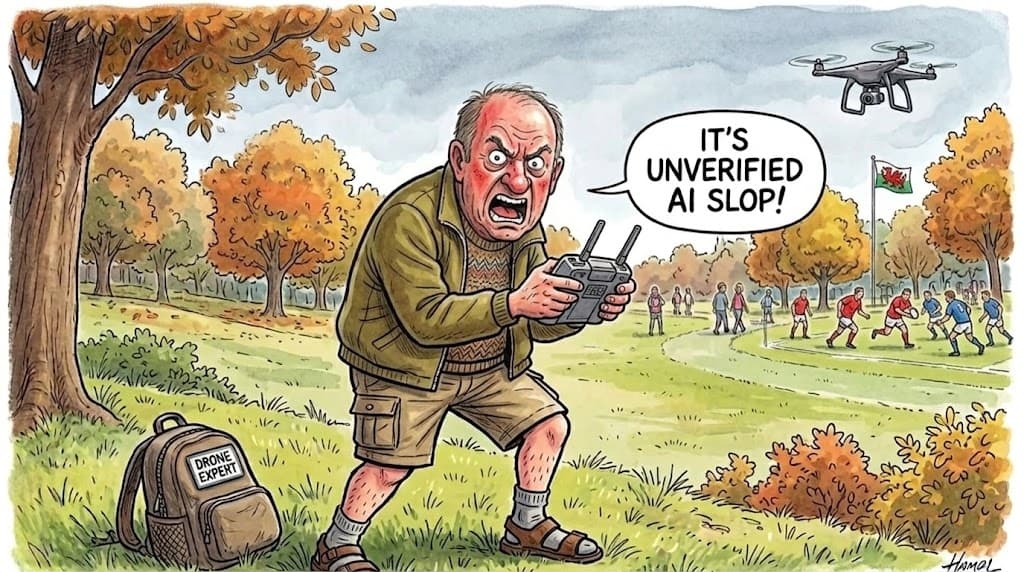
Every hobby has one, but the UK drone community has truly perfected the specimen.
Whenever you try pioneering new concepts and technologies in a notoriously guarded space, you will inevitably run into a Richard.
Or, to keep things short: a Dick.
Meet Dick: Our New Community Mascot
Dick doesn’t like new things.
Dick had to learn everything the hard way. He spent years squinting at confusing aviation charts, digging through clunky websites, and deciphering obscure acronyms. And because Dick had to suffer through all of that just to enjoy flying his drone, he firmly believes that you should have to suffer too.
In Dick’s eyes, if flying a drone isn't complicated, frustrating, and gatekept, you’re doing it wrong.
So whenever a modern tool comes along to make checking the sky simple, Dick pops up in the comments like clockwork:
"Avoid the unreliable AI slop! Only the old ways are verified and trusted!"
In Dick’s world, his personal opinion is basically aviation law. If he likes an old website, it’s holy and beyond question. If something makes life easier, it’s immediately branded dangerous "AI slop."
Now, as easy as it is to laugh and scroll past, here’s the funny part:
Dick actually has a point. He just doesn’t know what he’s talking about.
The Real Danger of "AI Slop"
Let’s be honest: using generic AI to tell you if the sky is safe would be a terrible idea.
If someone built a drone app that just asks ChatGPT, "Hey, is it safe to fly my drone here?"—that app would be an accident waiting to happen.
Generic AI tools are built to sound confident, not to be legally accurate. When they don’t know an answer, they just guess. Ask an off-the-shelf chatbot about drone laws, and it might cheerfully tell you that flying next to an airport is totally fine as long as you wave at the control tower.
That really is unreliable AI slop. And in aviation, guessing causes airspace breaches, police visits, and grounded drones.
If QuickSpotCheck used AI to decide whether a spot was safe, Dick would be completely right to complain.
So why don't we?
The Golden Rule: Computers Do the Maths. Zero AI.
At QuickSpotCheck, our rule is dead simple: AI is never allowed to decide if a flight is safe.
When you tap a spot on our map, the decision has nothing to do with AI, and nothing to do with anyone's personal opinion. It’s pure, cold maths based on official data:
- Official Airspace: Direct feeds from NATS and the Civil Aviation Authority.
- Live Temporary Notices: Real-time NOTAMs checked every 15 minutes.
- Ground Rules: Tens of thousands of mapped public boundaries (Forestry, Heritage, National Trust, Crown Estate, councils).
- Wildlife Sites: Official nature reserves and protected areas.
The computer checks your spot against the official maps. Is there a flight restriction zone? What altitude does it start at? Is it active right now?
There is no guessing. There is no probability. There is no AI opinion.
If the official map says you can't fly there, the app says RESTRICTED. Simple as that. We even lay our live data feeds, schedule calculations, and filtering steps bare for anyone to audit on our public Trust Portal.
So What Does the AI Actually Do? It Translates.
If computers do all the maths, why do we use AI at all?
Because official aviation notices are written like a cat walked across a 1970s teletype printer:
QWULW 26/042 EGTT 0120/0450
TEMPO DANGER AREA ACTIVATED RADIUS 3NM
SFC TO 3500FT AMSL. EXCLUDING VLOS UAS.
If you just want to head out on a Sunday morning to capture some scenic shots or fly a few batteries in peace, you shouldn't need an aviation degree to find out if a local crane or a temporary balloon notice affects you.
The only job we give AI is translating aviation jargon into plain English.
Once our system does the maths and confirms the facts, we hand those facts to an AI model with one clear instruction:
"Here are the verified facts. Explain what they mean in plain English so a normal person can understand them in five seconds."
And here's the key: the AI is locked to the facts. It cannot change a red zone to green. It cannot ignore a rule. It cannot make things up. It simply turns confusing aviation codes into everyday language.
You get the safety of official data, without having to decipher a secret code.
Don't Be a Dick
Healthy skepticism is good. Blindly trusting chatbots for flight safety is dumb.
But there’s a big difference between "unreliable AI guessing" and using smart tech to translate official facts into plain English.
Making flight safety accessible to everyone isn't "slop." It's common sense.
So next time you see a Dick in the comments insisting that everyone should still be suffering through the old, confusing way... smile, check your spot, trust the maths, and enjoy your flight.
And remember: don’t be a Dick.