DJI Neo 3: The Leak Breakdown, Spec Rumours, and Community Pulse
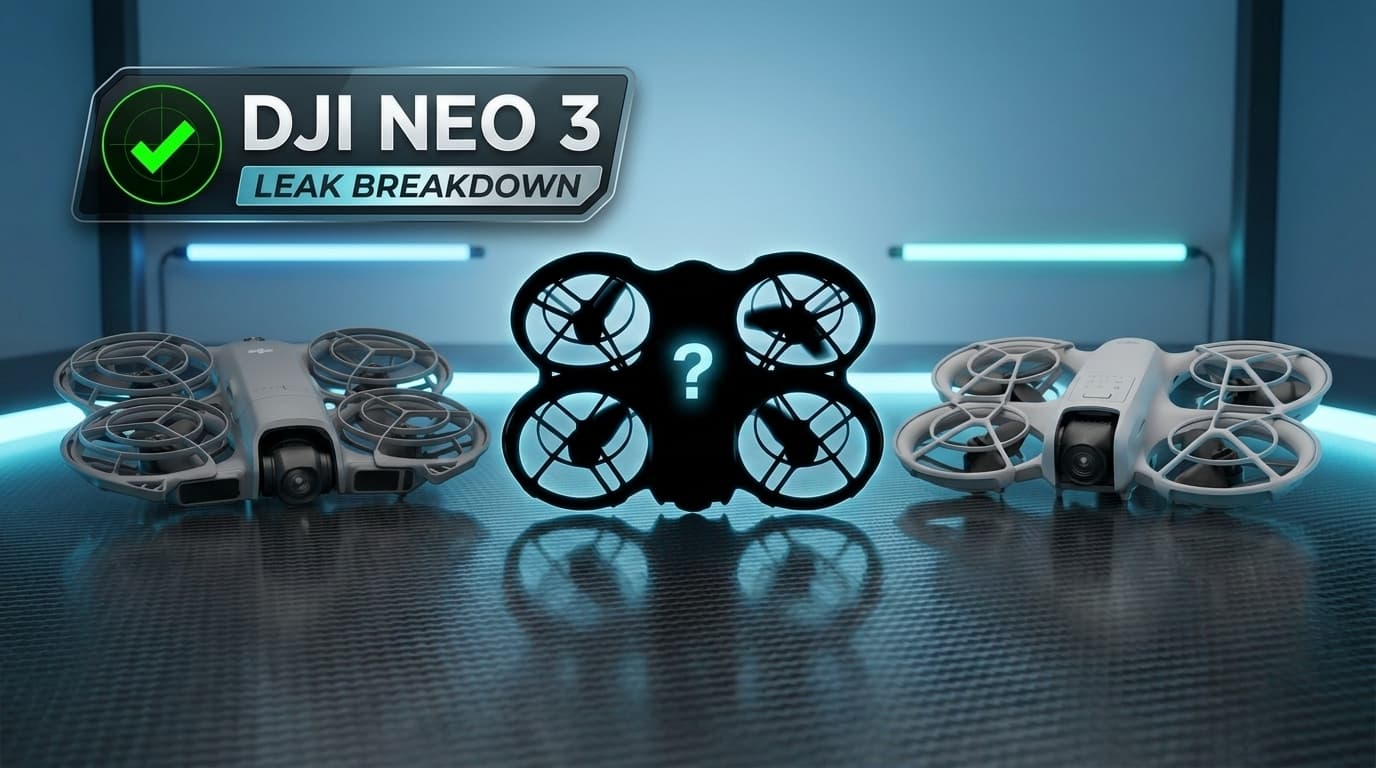
The consumer drone world moves fast, and right now, the rumour mill has hit fever pitch: early retail packaging leaks and circulating specification sheets for the unannounced DJI Neo 3 have surfaced online.
First spotted circulating across community channels via prominent industry leakers Jasper Ellens and Igor Bogdanov (@Quadro_News), the leaked data suggests that DJI is planning a substantial overhaul of their micro-drone platform—reportedly introducing a square 1/1.1-inch sensor, an all-new compact screen controller dubbed the DJI RC Mini, permanent molded prop cages, and an upgraded 3-cell powertrain.
The original Neo holds a special place for me. It was my personal gateway drug into the world of drones. Originally bought as an impulse purchase ahead of a trip to Bali—where I wanted effortless, palm-launched holiday footage without wrestling with bulky flight cases or intimidating tourists at coastal temples—it completely reset my expectations of what an ultra-compact flyer could do. But once back on home turf in the UK, those automated palm selfies quickly gave way to curiosity. Within weeks, I had bound it to a remote, switched into manual flight, and spent many hours buzzing low across farm fields, skimming damp grass, and weaving through hay bales. It wasn't long before that tiny ducted drone pulled me headfirst into high-power custom FPV quads.
Because the Neo 3 is still strictly unreleased and unannounced, we have to treat all current hardware details as preliminary leaks and rumours. However, by looking at what community pilots are debating across Reddit and YouTube—alongside the very real quirks of the original Neo and Neo 2—we can piece together what this next generation needs to get right, and what flying a sub-200g camera drone means under UK CAA regulations in 2026.
(Because community consensus takes time to mature and official retail units have yet to ship, this is a living report—we will continue updating this breakdown as more long-term flight data and durability feedback land over the coming weeks).
The Evolution: What Older Neos Got Right (and Where They Failed)
To understand why the Neo 3 leaks are causing such a stir, we have to look frankly at the strengths and pain points of the original Neo and Neo 2.
| Feature Area | Original Neo / Neo 2 Reality | Neo 3 Leaked Solution |
|---|---|---|
| Image Sensor | Small 1/2-inch sensor; noisy in British gloom; cropped vertical social video | Square 1/1.1-inch CMOS; native 9:16 and 16:9 at full sensor resolution; 2x lossless zoom |
| Controller Options | Phone Wi-Fi (laggy/short range), bulky RC-N3 phone clamp, or expensive £500+ FPV goggles | New standalone DJI RC Mini with built-in display and physical scroll wheel |
| Prop Protection | Clip-on plastic prop guards that could pop off or snap during rough grass landings | Permanent molded hub-and-spoke cages integrated directly into the airframe |
| Wind Authority | 135 g ultralight; drifted heavily in moderate UK gusts (Class 4 limit) | Heavier 192.7 g AUW backed by a 3-cell 18.9 Wh high-voltage powertrain |
| Obstacle Sensing | Neo 1 had downward vision only; Neo 2 added forward LiDAR & monocular sensing | Multi-directional sensory array integrated across arms, nose slit, and tail sensor |
The Flaws We Tolerated on the Original Neo:
- The Overcast Camera Struggle: The 1/2-inch sensor performed admirably in sunny tourist destinations, but the moment you flew it on an overcast UK afternoon, the footage turned muddy, shadow detail collapsed, and digital noise crept into the frame. Furthermore, cropping horizontal video into a vertical frame for Instagram Reels or TikTok degraded image clarity noticeably.
- The "Controller Tax": If you wanted to fly beyond 40 metres of phone Wi-Fi, you had two choices: carry the enormous DJI RC-N3 (which weighed more than three Neos combined and required clamping your smartphone in), or spend £500+ on DJI Goggles 3 and an FPV controller. There was no simple, pocket-friendly remote with its own screen.
- The Wind & Flyaway Scares: At just 135 g, sudden coastal breeze or high-altitude UK wind gusts pushed the drone into maximum tilt angles, resulting in battery sag and frantic drift warnings.
What We Learned from Older Models: Creator Testing
Because the DJI Neo 3 remains strictly unreleased, no reviewer has flown one yet. However, we can learn a massive amount about what the Neo 3 needs to solve by looking at how creators tested the previous generations. You can learn more about what our favourite YouTube creator said about the original Neo and Neo 2 below:
1. Squadding Quads: Real-World Testing on Previous Generations
Squadding Quads is our absolute favourite no-nonsense reviewer in the UK scene. No corporate spin, no sponsored excuses, and no flying spreadsheets—just honest testing in damp British weather with real grass-roots authenticity.
When putting previous iterations through real-world flight trials in DJI Neo 2 FPV FLIGHT - Why Did NO Reviewer Mention THIS Problem!?, Quads cut through the marketing hype to expose the practical quirks, flight handling, and mechanical limits of the platform:
Key Technical Takeaways from the Squadding Quads Testing of Earlier Models:
- Firmware Reliability & Flight Glitches: Quads highlighted crucial early firmware bugs where micro-drones could experience unexpected control locks or erratic behavior when switching between automated palm modes and manual flight.
- Durability in Real Grass: Testing the clip-on prop guards against real British terrain revealed that damp grass clippings easily jammed the ducted props, while hard landings dislodged the plastic clips.
- Manual Mode Reality Check: While DJI advertised "manual FPV mode", Quads demonstrated that aggressive stick inputs or high-speed pullouts hit artificial electronic throttles to prevent motor desync, meaning it is a gentle cruiser rather than an acrobatic freestyle rig.
- Acoustic Footprint: At close proximity, the high-pitch whine of micro ducted props can sound more irritating to dog walkers than larger, lower-RPM props—something pilots flying in public recreation parks need to bear in mind.
2. DC Rainmaker: Tracking & Action Sports Limits
Sports tech authority DC Rainmaker put the Neo series through rigorous cycling and running tracking tests, comparing it directly to high-end autonomous alternatives like the HoverAir X1 ProMax:
- Speed Ceiling: While palm tracking handled jogging or walking speeds flawlessly, the tracking algorithms frequently lost cyclists travelling above 25 km/h, particularly when moving under tree foliage or changing directional contrast.
- Action Sports Verdict: The Neo was crowned the king of budget accessibility, but serious outdoor athletes looking for high-speed downhill tracking found its tracking algorithms struggled to match dedicated tracking rigs.
3. Ian in London: UK Legal Realities & Field Workflows
UK drone specialist Ian in London focused on what matters most to British flyers: practical field setup, controller pairing, and CAA compliance:
- Operator ID & Labelling: Demonstrating where and how to label a sub-200g craft with your CAA Operator ID without interfering with downward optical flow sensors or airflow ducts.
- RF Link Reliability: Highlighting how mobile phone Wi-Fi links become erratic near residential Wi-Fi interference, reinforcing why a physical 2.4/5.8GHz remote is non-negotiable for safe UK flights.
Leaked Hardware Specs: Neo 1 vs Neo 2 vs Neo 3
Based on circulating retail packaging leaks and technical specification sheets shared online this week, here is how the rumoured Neo 3 stacks up against both the original DJI Neo and the DJI Neo 2:
| Specification | DJI Neo 1 | DJI Neo 2 | DJI Neo 3 (Leaked) |
|---|---|---|---|
| Takeoff Weight (AUW) | 135 g (C0) | ~135–145 g (C0) | 192.7 g (Sub-249g Open A1) |
| Camera Sensor | 1/2-inch CMOS (12 MP, f/2.8) | 1/2-inch CMOS (12 MP, f/2.2) | 1/1.1-inch Square CMOS |
| Aspect Ratio / Framing | 16:9 (1080p vertical crop) | 16:9 (2.7K vertical crop) | Native 4K 9:16 & 16:9 (Full Sensor) |
| Video Capabilities | 4K @ 30fps / 1080p @ 60fps | 4K @ 60fps / 4K @ 100fps Slow-Mo | 4K @ 60fps HDR / 2x Lossless Zoom |
| Dedicated Controller | RC-N3 (Phone clamp) | RC-N3 / RC 2 (Transceiver req.) | DJI RC Mini (Built-in screen) |
| Obstacle Sensing | Downward vision only | Forward LiDAR + Monocular Vision | Omnidirectional Array + Tail Lens |
| Internal Storage | 22 GB | 49 GB | Expanded Onboard + microSD |
| Battery Architecture | 2-cell 1435 mAh (5.1 Wh) | 2-cell Intelligent Flight Battery | 3-cell 1800 mAh (18.9 Wh) |
| UK Standalone Price | From £119–£169 | From £209 (£349 Fly More) | Est. ~£240–£300 (Combo) |
The Leaked Game-Changers: Sensor & The RC Mini
Two specific hardware revelations from circulating spec leaks stand head-and-shoulders above the rest:
1. The 1/1.1-Inch Square Sensor
Instead of installing a traditional rectangular sensor that requires a motorized rotating gimbal mechanism (like the Mini 4 Pro) or forcing a resolution-destroying digital crop, the Neo 3 leaks point to a square sensor architecture borrowed from DJI's action camera division.
Because the sensor is square, the camera captures an expansive field of view simultaneously. The processor can output native 4K horizontal video (16:9) or native 4K vertical video (9:16) without losing pixel density or physically turning the camera. For content creators posting to YouTube, TikTok, and Instagram, this eliminates the single biggest frustration of budget aerial video. Furthermore, the massive jump from a 1/2-inch to a 1/1.1-inch sensor allows significantly more light intake for clean evening and twilight shots.
2. The Leaked DJI RC Mini Controller
For casual pilots, having to slide a smartphone into a heavy RC-N3 clamp, plug in an OTG cable, and wait for the DJI Fly app to boot completely undermined the grab-and-go ethos of a micro-drone.
Circulating retail packaging leaks show the DJI RC Mini listed alongside the Fly More combo: a genuinely pocket-sized controller with an integrated high-contrast LCD screen, direct scroll wheel navigation, and standalone telemetry. You pull the drone from one pocket, the RC Mini from the other, power both on, and you are in the air in ten seconds flat with rock-solid physical stick control.
The Hidden Friction: Batteries, Weight, and Real-World Gotchas
While early leak threads are buzzing with excitement, practical drone ownership comes with trade-offs that marketing spec sheets gloss over:
- The Battery Ecosystem Break: The leaked 3-cell 18.9 Wh battery features a distinct slotted top, 4 power check LEDs, and an entirely new physical form factor. Your existing Neo 1 or Neo 2 batteries and charging hubs will not work. If you invested in multiple flight packs for previous models, none of them will carry forward.
- The 192.7 g Weight Penalty (+42% Heavier): Going from 135 g to 192.7 g gives the drone much-needed wind penetration, but heavier mass significantly alters crash dynamics. While a 135 g Neo would frequently bounce off a tree branch or soft drywall without harm, a nearly 200 g drone carries substantially more kinetic energy on impact.
- The Molded Prop Cage Trap: On earlier models, breaking a prop guard was an inexpensive £5 plastic swap. The Neo 3 integrates the hub-and-spoke cages directly into the structural arm molding. If a heavy tumble cracks or snaps a spoke, field repair becomes far more complex than snapping on a fresh guard.
- The Price Creep Risk: The original Neo won the community because at £169 standalone, it was an impulse buy. With a 1/1.1-inch sensor, omnidirectional obstacle sensors, and a screen-equipped RC Mini controller, early European leak pricing suggests combos may push closer to €280–€350 (~£240–£300). If true, it shifts the Neo 3 from a casual toy into serious entry-level camera drone territory.
The Community Pulse: What Pilots Are Debating Right Now
Scanning reaction threads across Reddit (r/dji, r/fpv), YouTube comments, and the Grey Arrows Drone Club forum, community sentiment falls into three distinct camps:
- The Solo Content Creators: Overwhelmingly enthusiastic. The combination of a 1/1.1-inch square sensor and palm-takeoff tracking solves the vertical video bottleneck. As one Reddit commenter noted: "If this does native 4K vertical without a rotating gimbal and has real obstacle avoidance, my action camera is staying in my backpack."
- The FPV / Acro Camp: Skeptical of the weight gain. FPV hobbyists who used the original Neo as an indestructible backyard micro-cinewhoop are concerned that 192.7 g will make the quad feel sluggish in tight dives, while proprietary flight software will still lock pilots out of genuine Betaflight tuning.
- The Controller Relief: Huge praise for the leaked RC Mini. Community forums have long begged DJI for a mini screen remote that doesn't cost £250+ like the RC 2, making the RC Mini the sleeper hit of the entire leak cycle.
The UK Flight & Regulatory Angle: Where Can You Fly Legally?
For pilots in the UK, understanding how the Neo 3 fits into Civil Aviation Authority (CAA) regulations is vital before taking to the skies:
- Weight Classification (Sub-250 g): At 192.7 g, the Neo 3 sits safely below the critical 250 g threshold. Under UK Open Category rules, it flies within the Open A1 ("Fly Over People") sub-category. You can fly close to uninvolved bystanders and perform transient overflight (though you must never fly intentionally over assemblies of people or crowds).
- The CAA 100 g Threshold & Operator ID: Because the Neo 3 weighs over 100 g and carries a camera, you legally must hold a valid UK Operator ID (£11/year from the CAA) and display your Operator ID number physically on the aircraft chassis. Anyone flying it must also take the free online theory test to obtain a Flyer ID.
- Follow-Me Mode Distance Rules: If you use the Neo 3's autonomous tracking while jogging, cycling, or walking, UK CAA CAP 722 rules mandate that the aircraft must remain within 50 metres of the remote pilot, and you must maintain visual line of sight (VLOS) or have an observer monitoring the flight path.
- Night Flying: If you plan to capture twilight or evening video, remember that UK regulations require all drones flown at night to carry a functioning flashing green light visible from the ground.
Don’t Fall for the "Sub-250g Fly Anywhere" Myth
The biggest mistake new micro-drone owners make in the UK is assuming a sub-250g drone can be launched anywhere. National Trust estates, Forestry England woodlands, local council parks with drone bylaws, SSSI nature reserves, and airport Flight Restriction Zones (FRZs) strictly restrict takeoff and landing—and 400ft wind gusts can still catch a 192g craft off guard. Run a free 10-second spot check on the QuickSpotCheck app before you palm-launch:
The Lowdown Verdict: Is the Neo 3 Worth Waiting For?
- Who should buy it: Total newcomers looking for the ultimate friction-free entry into aerial photography, mobile creators who prioritize vertical social video, and existing drone pilots who want a genuine pocket-sized flyer with a dedicated screen remote.
- Who should skip it: Experienced pilots looking for 10-bit D-Log M colour grading, extreme long-range transmission, or aggressive FPV acro freestyle capabilities. If you already own a DJI Mini 4 Pro, your image quality and wind resistance remain in a higher class.
Editorial Integrity & Creator Credits
QuickSpotCheck does not accept paid manufacturer promotions, free review units, or affiliate kickbacks. This article is an independent editorial breakdown synthesising circulating retail box leaks, public specification sheets, previous generation creator teardowns, and community sentiment.
- Squadding Quads: Media and flight testing cited with credit to Squadding Quads on YouTube. Embedded media streams directly via YouTube's official player, crediting watch time directly to the creator.
- Jasper Ellens & Igor Bogdanov (@Quadro_News): Leaked retail box images, unboxing video clips, and spec data cited with credit to their independent reporting.
- DC Rainmaker & Ian in London: Autonomous tracking insights and UK regulatory workflows cited with credit to their respective creator channels.
- DJI: "DJI", "Neo", and related trademarks belong to SZ DJI Technology Co., Ltd. We are an independent aviation platform and are not affiliated with or endorsed by DJI.